Cell cell cell have you any walls.
If so if so you are a plant cell.
Don't be discouraged if you dont have walls.
It's alright because you're an animal cell.
Prokaryotes and eukaryotes,
all bounded by a plasma membrane.
Eukaryote eukaryote you have a true nucleus
Yes yes prokaryotes are different
Becausee cause they hold their DNA in the nucleiod.
All goes well when ribosomes build's a cell's protein.
They take care of the metabolism changes in the body.
The same goes for the endoplasmic reticulum
One side is smooth the other side is rough
Don't be afraid remembering them is tough.
The smooth ER provides synthesis of lipids
The rough ER provides synthesis of secretory proteins.
The golgic apparatus finishes and sorts.
Ends up shipping cell products to all parts.
Lysosomes are digestve compartments.
One process known as phagocytosis.
Cell cell cell
why are you so complex
the cell membrane has glycoproteins
and a bilayer.
The cell is fluid and moves all about
This is the end of our cell poem
Don't be discouraged there's more to learn.
The cell is a complex part of the body.
Friday, January 20, 2012

Wednesday, January 18, 2012
Prion Vs. Protist Vs. Bacteria Vs. Virus
Prion:
Viroids and prions are infectious agents even simpler than viruses. A prion is a protein, they appear to cause a number of degenerative brain diseases, including scrapie in sheep, the "made cow disease" and Creutzfeldt-Jacob disease in humans. A prion is a misfolded form of a protein normally present in brain cells. When the prion gets into a cell containing the normal form of the protein, the prion converts the normal protein to the prion version. Because of this we can see that prions always calls chain reactions that increase the prion number. The hypothesis of how a prion propagate is this: when a prion contacts a normal "twin" it may induce the normal protein to assume the abnormal shape. This may continue until prions go to dangerous levels such as causing cellular malfunction and soon degeneration of the brain.

Protist:
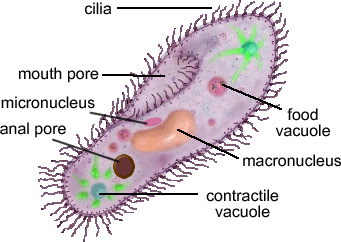
Protists are the most diverse of all eukaryotes. Most protists are unicellular. They are found whereever there is water, living as plankton, submerged bottom swellers, or inhabitants of moist soil or the body fluids of other organisms. Protists are the most nutritionally diverse, this includes photoautotrophs, heterotrophs, and mixotrophs. Some algae which is in the protist tree have life cycles with alternating multicellular haploid and diploid generations, this means that haploid gametophytes and diploid sporophytes take turns reproducing one another. . The main groups of Protistan diversity are Diplomonadida, Parabasala, Euglenozoa, Alveolata, Stramenopila, Rhodophyta, Chlorophyta, and Mycetozoa.

Bacteria:
Bacteria have a short generation span and because of this it helps them adjust to changing environments. Since bacteria has a short generation span, new mutations can affect a population's genetic variation quickly. The way a bacteria duplicates and makes new bacteria is by transformation, transduction, and conjugation. In transformation, the DNA enters the cell from the surroundings. In transduction, the bacterial DNA is carried from one cell to the other by phages. Lastly, in conjugation, it is the transfer of genetic material between bacterial cells by direct cell-to-cell contact or by a bridge-like connection between two cells.

Virus:
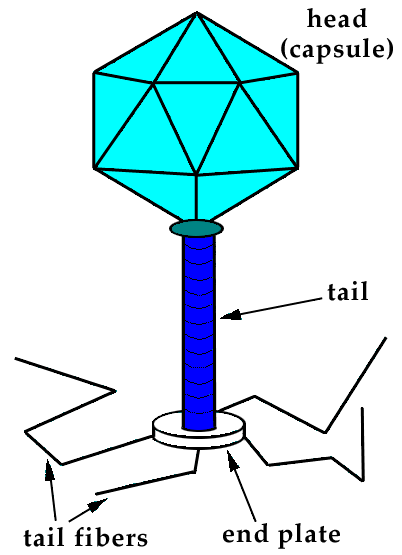
A virus is a small nucleic acid genome enclosed in a protein capsid and sometimes a membranous envelope. The genome that is enclosed in the capsid may be single- or double stranded DNA as well as RNA. The only way for a virus to reproduce is within a host. Viruses use enzymes, ribosomes, and small molecules of host cells to synthesize offspring viruses. For RNA viruses, there is such thing known as retroviruses, that they do is that they use the enzyme reverse transcriptase to synthesize DNA from their RNA template. The DNA can then integrate into the host genome as a proviruses. As for plant viruses, most of them are single stranded RNA viruses. Phages, a type of viruses can undergo the lytic or lysogenic cycle in order to reproduce.

SOURCES: campbell book, biologycorner.com,
Viroids and prions are infectious agents even simpler than viruses. A prion is a protein, they appear to cause a number of degenerative brain diseases, including scrapie in sheep, the "made cow disease" and Creutzfeldt-Jacob disease in humans. A prion is a misfolded form of a protein normally present in brain cells. When the prion gets into a cell containing the normal form of the protein, the prion converts the normal protein to the prion version. Because of this we can see that prions always calls chain reactions that increase the prion number. The hypothesis of how a prion propagate is this: when a prion contacts a normal "twin" it may induce the normal protein to assume the abnormal shape. This may continue until prions go to dangerous levels such as causing cellular malfunction and soon degeneration of the brain.

Protist:
Protists are the most diverse of all eukaryotes. Most protists are unicellular. They are found whereever there is water, living as plankton, submerged bottom swellers, or inhabitants of moist soil or the body fluids of other organisms. Protists are the most nutritionally diverse, this includes photoautotrophs, heterotrophs, and mixotrophs. Some algae which is in the protist tree have life cycles with alternating multicellular haploid and diploid generations, this means that haploid gametophytes and diploid sporophytes take turns reproducing one another. . The main groups of Protistan diversity are Diplomonadida, Parabasala, Euglenozoa, Alveolata, Stramenopila, Rhodophyta, Chlorophyta, and Mycetozoa.
Bacteria:
Bacteria have a short generation span and because of this it helps them adjust to changing environments. Since bacteria has a short generation span, new mutations can affect a population's genetic variation quickly. The way a bacteria duplicates and makes new bacteria is by transformation, transduction, and conjugation. In transformation, the DNA enters the cell from the surroundings. In transduction, the bacterial DNA is carried from one cell to the other by phages. Lastly, in conjugation, it is the transfer of genetic material between bacterial cells by direct cell-to-cell contact or by a bridge-like connection between two cells.

Virus:
A virus is a small nucleic acid genome enclosed in a protein capsid and sometimes a membranous envelope. The genome that is enclosed in the capsid may be single- or double stranded DNA as well as RNA. The only way for a virus to reproduce is within a host. Viruses use enzymes, ribosomes, and small molecules of host cells to synthesize offspring viruses. For RNA viruses, there is such thing known as retroviruses, that they do is that they use the enzyme reverse transcriptase to synthesize DNA from their RNA template. The DNA can then integrate into the host genome as a proviruses. As for plant viruses, most of them are single stranded RNA viruses. Phages, a type of viruses can undergo the lytic or lysogenic cycle in order to reproduce.
SOURCES: campbell book, biologycorner.com,
Virtual Diffusion Lab

To have the highest rate of diffusion :
Surface area: 6008.89
Volume: 4.00
Surface area/volume ratio: 1500.84
Villi: 50%
Radius: 1X
Cell shape: 10:1
Number of dimples: 20
Dimple % of cell surface area: 1
SOURCES: http://www.mhhe.com/biosci/genbio/biolink/j_explorations/ch02expl.htm
Tuesday, January 17, 2012
Cellular Metabolism Wordle

The chemistry of life is organized into metabolic pathways. Metabolism is a collection of chemical reactions that occur in an organism. It is aided by enzymes particularly, this is how it follows catabolic pathways or anabolic ones. The difference between the two is that catabolic means to break up while anabolic means to build. Cellular respiration and fermentation are catabolic, energy-yielding pathways. The most important part to remember in these few chapters is that respiration involves glycolysis, the krebs cycle, and the electron transport. Glycolysis and the Krebs cycle supply electrons to the transport chain. The places in which these processes occur is that glycolysis occurs in the cytosol, the krebs cycle in the mitochondrial matrix and the electron transport chain is built into the inner mitochondrial membrane. When there is no oxygen for cellular respiration to occur, fermentation enables some sells to produce ATP without the help of oxygen. One extremely important thing to remember is that ATP is basically the cell's energy shuttle. ATP drives endergonic reactions by the transfer of the phosphate to specific reactants. It comes from ADP and turns into ATP after the phosphate is added in. As for photosynthesis, the organic compounds produced by photosynthesis provide the energy and building material for ecosystems.
SOURCES: Campbell book and wordle.net
Cell Wordle

The importance of these few chapters is that we know that prokaryotes were the first organisms on Earth. From there we are able to see that the Bacteria and archaea are the two main branches of prokaryote evolution. Nearly all prokaryotes have a cell well external to the plasma membrane. In order to tell if a bacteria is gram-postive and gram-negativem we can do a gram stain. Bacteria differ in the structure of their walls when we try to distinguish between the gram positive and negative.. Prokaryotes can be grouped into four categories according to how they obtain energy and carbon, this is how we have groups like the photoautotrophs, chemoautotrophs, photoheterotrophs, and the chemoheterotrophs. All fungi are heterotrophs and they acquire their energy and nutrients by absorption. The importance on fungi is that ecosystems depend on fungi as decomposers and symbionts. Without fungi and bacteria as decomposers, communities would not have the blessing of chemical recycling.
SOURCES: campbell book and wordle.net
Bacterial Transformation
The main objective of this experiment was that Boyer and Cohen wanted to isolate the recombinant plasmid, but in order to do so they had to first get their ligated plasmids into E.coli. They learned that Pneumococcus bacteria are "transformed" to virulence when they take up DNA from virulent strains. Their experiment continued by them performing a "heat shock" by rapidly raising and lowering the temperature. Because they did this the bacteria was able to take in the plasmic DNA. The bacteria is then placed in a petri dish and the bacteria with resistance to antibiotics )tetracyline and kanamycin) will be able to grow and continue to spread. This foreign DNA is otherwise known as transformation.
-The cell membrane is made up of lipid molecules that have negatively charged phosphates. The negatively charged phosphates on the DNA helix are repelled by the ones on the lipids. Heat shock creates a temperature imbalance on either side of the bacterial membrane. This is how the DNA is able to get through the adhesion zone.

SOURCES: http://www.dnalc.org/view/15916-DNA-transformation.html, bacteriakingdoms.com
-The cell membrane is made up of lipid molecules that have negatively charged phosphates. The negatively charged phosphates on the DNA helix are repelled by the ones on the lipids. Heat shock creates a temperature imbalance on either side of the bacterial membrane. This is how the DNA is able to get through the adhesion zone.

SOURCES: http://www.dnalc.org/view/15916-DNA-transformation.html, bacteriakingdoms.com
Thursday, January 12, 2012
Three Beneficial Bacteria:
Lactobacillus:
Lactobacillus species are used for the production of yogurt, cheese, sauerkraut, and other fermented foods. Lactobacillus is used for treating and preventing diarrhea. It is also used to prevent and treat diarrhea associated with using antibiotics. Some people use lactobacillus for general digestion problems, while others use it used for skin disorders such as fever blisters and canker sores. Many lactobacilli are unusual in that they operate using homofermentative metabolism this is why eating yogurt can sometimes improve your digestive system because lactobacillus is a bacteria that lives in our digestive, urinary, and genital systems without causing any diseases.

Rhizobia:
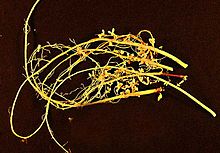
Rhizobia are soil bacteria that fix nitrogen after becoming established inside root nodules of legumes. Rhizobia require a plant host and they cannot fix nitrogen themselves. They are gram-negative, motile, non-sporulating rods. It is known that this bacteria is able to enrich the soil by contributing nitrogen through symbiotic nitrogen fixation by Rhizobium through centuries. Without this bacteria we would not be able to sustain the natural resources of the ecosystem.

Ruminococcu:
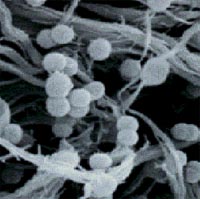
Ruminococcus are non-motile organisms with a coccoid shape. They are also non-motile bacteria. They obtain nutrients by breaking down cellulose that comes through the digestive system of the host organism. These organisms are also capable of fermenting glucose and xylose. Ruminococcus inhabits the rumen of cattle, sheep, and goats. These organisms allow their hosts to digest cellulose. Ruminococcus' cellulose degredation abilities are currently a major area of study. By understanding how these organisms degrade cellulose, farmers may be able to make advances in animal productivity. Ruminococcu is beneficial because without this animals like cows and sheep would not be able to digest most of the food that they eat like celluose.

SOURCES: http://www.buzzle.com/articles/beneficial-bacteria.html
http://www.indiaagronet.com/indiaagronet/manuers_fertilizers/contents/rhizobium.htm
http://microbewiki.kenyon.edu/index.php/Ruminococcus
Lactobacillus:
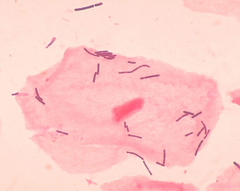
Lactobacillus species are used for the production of yogurt, cheese, sauerkraut, and other fermented foods. Lactobacillus is used for treating and preventing diarrhea. It is also used to prevent and treat diarrhea associated with using antibiotics. Some people use lactobacillus for general digestion problems, while others use it used for skin disorders such as fever blisters and canker sores. Many lactobacilli are unusual in that they operate using homofermentative metabolism this is why eating yogurt can sometimes improve your digestive system because lactobacillus is a bacteria that lives in our digestive, urinary, and genital systems without causing any diseases.
Rhizobia:
Rhizobia are soil bacteria that fix nitrogen after becoming established inside root nodules of legumes. Rhizobia require a plant host and they cannot fix nitrogen themselves. They are gram-negative, motile, non-sporulating rods. It is known that this bacteria is able to enrich the soil by contributing nitrogen through symbiotic nitrogen fixation by Rhizobium through centuries. Without this bacteria we would not be able to sustain the natural resources of the ecosystem.
Ruminococcu:
Ruminococcus are non-motile organisms with a coccoid shape. They are also non-motile bacteria. They obtain nutrients by breaking down cellulose that comes through the digestive system of the host organism. These organisms are also capable of fermenting glucose and xylose. Ruminococcus inhabits the rumen of cattle, sheep, and goats. These organisms allow their hosts to digest cellulose. Ruminococcus' cellulose degredation abilities are currently a major area of study. By understanding how these organisms degrade cellulose, farmers may be able to make advances in animal productivity. Ruminococcu is beneficial because without this animals like cows and sheep would not be able to digest most of the food that they eat like celluose.
SOURCES: http://www.buzzle.com/articles/beneficial-bacteria.html
http://www.indiaagronet.com/indiaagronet/manuers_fertilizers/contents/rhizobium.htm
http://microbewiki.kenyon.edu/index.php/Ruminococcus
Subscribe to:
Posts (Atom)